October 6, 2026
Why Full-Color Booklet Printing Still Matters for Local Business Marketing
By @zymaf040md
When I started working with small businesses in Lancaster on their printed marketing materials, I noticed a pattern. Many of them had shifted almost entirely to digital outreach and were surprised when I suggested a printed booklet. But after they held the first proof in their hands, something clicked. A well-made booklet feels different. It has weight, texture, and permanence. And when it is produced with full-color booklet printing, the result can be a powerful tool for building trust and conveying professionalism.
Over the years, I have watched business owners invest heavily in website design and social media campaigns, only to realize that a physical piece of collateral often closes a sale faster than a landing page. There is a reason for that. A printed booklet lives on a desk or a coffee table. It gets passed around. It gets read during downtime. And if it is printed well, with accurate color and a finish that feels good to the touch, it reflects directly on the quality of the business that produced it.
Understanding the Production Choices
One of the first decisions you face with full-color booklet printing is which printing method to use. Offset printing and digital printing each have their place. For a run of 500 booklets or more, offset printing typically gives you the best cost per unit and the most consistent color reproduction. Heidelberg presses, for example, are a staple in the industry for a reason. They deliver sharp detail and uniform ink coverage across the entire print run. For shorter runs, digital printing offers faster turnaround and lower setup costs, though you may sacrifice some of the color precision that offset can achieve.
Color accuracy is another area where experience matters. Most commercial printers use the CMYK color model to reproduce images. But not all CMYK is created equal. A printer that follows Fogra standards, for instance, will give you a predictable result that matches what you see on a calibrated monitor more closely. If you have a specific brand color that must be exact, the Pantone Matching System is your best friend. I have seen clients spend hours tweaking a logo color on screen, only to be disappointed when the printed version looks different. Specifying a Pantone spot color for your cover or key elements can eliminate that guesswork.

Paper and Finish: The Feel of Quality
The substrate you choose affects not only the look but the perceived value of your booklet. Coated paper gives you a smooth surface that makes images pop and holds fine detail well. It is a common choice for photo-heavy projects like portfolios or product catalogs. Uncoated paper, on the other hand, has a more natural, tactile feel. It absorbs ink differently, which can give a softer, more understated look. For a training manual or a corporate brochure, uncoated paper can communicate approachability and substance.
Finishing options add another layer of decision. UV coating provides a high-gloss shine and protects the surface from fingerprints and scuffs. Matte lamination gives a sophisticated, low-glare finish that resists wear and feels smooth. Spot UV is a technique where you apply a glossy coating only to specific areas, like a logo or a headline, creating a contrast against a matte background. I have used spot UV on booklet covers for a local Lancaster arts organization, and the result was striking. It drew the eye exactly where we wanted it.
Binding That Works for Your Project
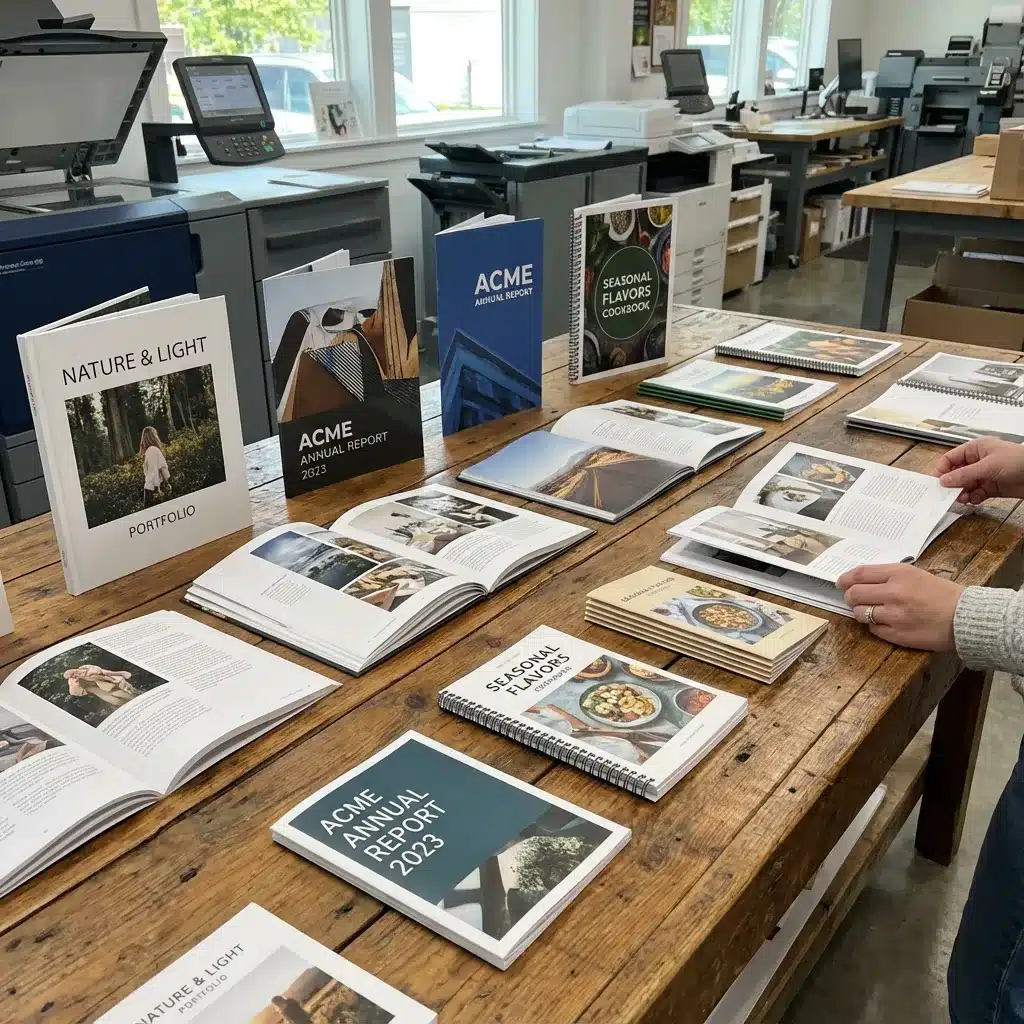
Binding is not an afterthought. It determines how your booklet opens, how flat it lies, and how durable it is. Saddle stitching is the most economical method for booklets up to about 48 pages. Staples are placed in the fold line, and the pages open fully. It works well for event programs, short catalogs, and menus. For thicker booklets, perfect binding is the standard. The pages are glued into a wraparound cover, giving a clean, book-like spine. Training manuals and annual reports often use perfect binding because it holds up to repeated handling.
Spiral binding is another option, particularly for workbooks or reference guides that need to lie flat when open. Plastic coils or wire loops allow the pages to turn 360 degrees, which is handy for hands-on use. I once produced a spiral-bound field guide for a local nonprofit, and the staff appreciated being able to fold it back on itself while working outdoors. The choice of binding affects your trim size and bleed requirements, so it is wise to decide early.
Getting the Technical Details Right
Bleed and trim size are two terms that every designer should know. Bleed is the extra area beyond the final cut line, usually 1/8 inch on each side. It ensures that when the booklet is trimmed, there are no unprinted white edges. If you have a background color or an image that extends to the edge, you must set up your file with proper bleed. Trim size is the final dimension of your booklet after cutting. Standard sizes like 8.5 x 11 inches are economical, but a custom trim size can make your booklet stand out on a crowded table.

Another factor is the cover stock. A heavier paper for the cover, often 100 lb or higher, gives the booklet rigidity and a premium feel. Self-cover booklets use the same paper throughout, which is lighter and more flexible but less substantial. For a one-time event program, self-cover may be perfectly adequate. For a piece that represents your brand, investing in a separate cover stock is usually worth it.
When Full-Color Booklet Printing Shines
I have worked on booklets for real estate agencies, local manufacturers, and arts groups in Lancaster. The common thread is that each of them needed to communicate a lot of information in a format that people would actually want to read. A gatefold booklet, for example, opens like a map and creates an immediate sense of discovery. It is a great format for a welcome packet or a high-end sales brochure. Full-color booklet printing allows you to use photography, charts, and illustrations without compromise. The richness of the images tells a story that black-and-white or spot-color printing cannot match.
One project that stands out was a portfolio booklet for a local furniture maker. The client had beautiful photographs of their work, but the images looked flat on screen. When we printed them on a coated paper with UV coating, the grain of the wood and the sheen of the finish were visible. The booklet became a sales tool that the maker could leave with a designer or an architect. It closed deals because it showed craftsmanship in a way that a PDF never could.
Practical Advice for Your Next Project
If you are planning a full-color booklet printing project, here are a few tips I have learned the hard way:
- Request a hard proof before the full run. A screen proof cannot show you the exact paper color or the feel of the finish.
- Check your images for resolution. Anything below 300 dpi will look soft in print.
- Talk to your printer about the binding method early. Saddle stitching and perfect binding have different page count limits.
- Order a few extra copies. Reprinting a small quantity later is expensive compared to adding them to the initial run.
I have also found that working with a local printer in Lancaster makes a difference. Being able to walk in, look at paper samples, and discuss the project face to face saves time and prevents misunderstandings. You can see how the ink sits on different stocks and get immediate feedback on your file setup. That kind of collaboration is harder to achieve with an online-only vendor.
Why It Still Works
In an era of constant notifications and scrolling, a printed booklet offers a pause. It asks for attention on its own terms. And when that booklet is produced with care, using the right combination of paper, binding, and finish, it becomes more than information. It becomes a representation of your values. Full-color booklet printing is not just about making things look pretty. It is about creating something that people want to hold onto. That is why, for many businesses in Lancaster and beyond, it remains an essential part of the marketing mix.
❧